The impulse-buy era isn’t slowing down — but Americans are finally striking back. The 30-day rule impulse spending method is making a massive comeback on TikTok, Reddit, and personal finance forums, with people reporting hundreds saved by simply waiting before hitting “Buy Now.”
If your cart is always full, your bills feel tight, and your paycheck keeps disappearing, this hack is about to become your new best friend.
💡 What Exactly Is the 30-Day Rule?
At its core, the 30-day rule impulse spending strategy is simple:
Whenever you want to buy something non-essential, wait 30 days.
If you still want it after 30 days, buy it. If not — you just saved money.
It sounds almost too easy. But it works because:
- Most impulse buys lose their appeal in 48 hours
- The brain loves novelty more than the item itself
- Time reveals whether the purchase supports your actual goals
This rule essentially introduces friction into your spending. And friction is what impulse buying hates most.
🧠 Why This Hack Works So Well (According to Behavioral Psychology)
Impulse buying isn’t really about money — it’s about emotion.
You buy because you’re stressed, tired, bored, or just hit with a targeted ad at the exact wrong moment. The 30-day rule impulse spending method interrupts that emotional reaction and gives your logical mind time to take over.
Here’s what actually happens during those 30 days:
1. The dopamine spike fades
Most impulse purchases feel exciting for minutes — not months.
2. Your financial goals speak louder
Without the rush, you remember:
“I wanted to pay down debt.”
“I’m saving for a vacation.”
“I’m trying to stop living paycheck to paycheck.”
3. Price becomes reality
$39 here, $22 there, $58 later — it all adds up. With time, the math finally matters.
4. You discover cheaper alternatives
Many people find the item on sale later…
or realize they had something similar at home…
or simply forget about the item entirely.
Time isn’t just money — time protects money.
📱 How to Use the 30-Day Rule in the Real World
Let’s make this practical. Here’s how to implement the method starting today:
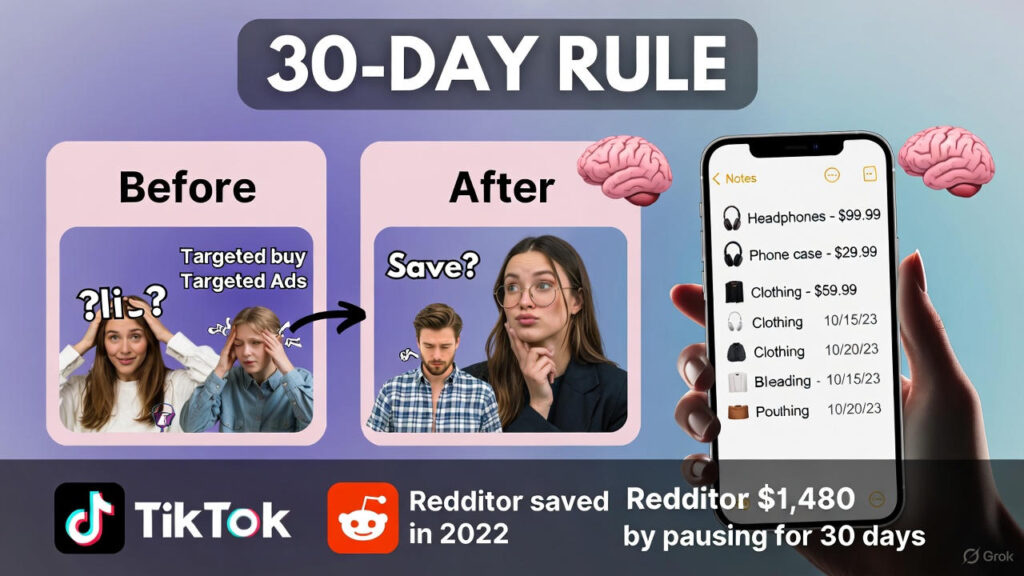
Step 1 — Create a “30-Day List”
A simple Notes app page works.
Every time you want something non-essential, write:
- The item
- Price
- Date added
- Why you want it
Step 2 — Walk away
Don’t add it to your cart. Don’t revisit the item. Don’t “just check” again.
If you think about it tomorrow, add notes.
If you don’t, even better.
Step 3 — Revisit the list after 30 days
Ask yourself:
- Do I still want this?
- Does it improve my life?
- Does it align with my financial goals?
- Would I still buy it if it wasn’t on sale?
Step 4 — Decide mindfully
If the answer is no — you win.
If the answer is yes — buy it without guilt.
🧮 How Much Can You Actually Save?
Most people underestimate their impulse spending by a lot.
Based on surveys from financial apps and budgeting platforms, the average American spends between $100–$300 each month on impulse purchases.
Using the 30-day rule impulse spending system can slash that number dramatically.
A few real examples:
- One Redditor reported saving $1,480 in four months
- A TikTok creator said it cut her Amazon spending by 70%
- A budgeting coach tracked $2,300 saved in a single year
This rule doesn’t require cutting out fun — it just filters out regret.
🛍️ What Items Benefit Most From the 30-Day Rule?
Use it on:
- Tech accessories
- Home decor
- Clothing
- Kitchen gadgets
- Beauty products
- Subscription add-ons
- Random TikTok finds
- Amazon lightning deals
Don’t use it on:
- Groceries
- Medicine
- Bills
- Emergency purchases
Use it strategically, not excessively.
⚡ A Quick Add-On Hack: The 72-Hour Mini Rule
Some people use a “lite” version when 30 days feels too long.
For anything under $50:
Wait 72 hours instead of 30 days.
It’s the perfect entry point for beginners — and it still kills most impulse buys instantly.
🧭 The Wink Take
Small delays lead to big wins.
The 30-day rule impulse spending hack works because it’s simple, psychological, and brutally effective. If you want an easy way to stop draining your bank account without feeling deprived, this rule is your low-effort, high-impact financial shield.
🔗 Read Next on DollarWink
👉 https://dollarwink.com/cancel-subscriptions-2025-saved-1247/