U.S. consumers just sent a message—and it’s the economic equivalent of slamming the brakes. The latest University of Michigan report shows that consumer sentiment crashes to its lowest point in nearly 3½ years, signaling rising financial anxiety, weakening optimism, and mounting recession whispers across America.
This wasn’t a wobble.
This was a collapse.
And it’s happening at a moment when the U.S. economy can least afford it.
Over the last 24 hours, new data reveals a sharp, unexpected plunge in how Americans feel about their finances, jobs, inflation, and the future. Economists warn that the combination of rising prices, job insecurity, and an ongoing government shutdown is becoming toxic.
Consumer sentiment drives 70% of the U.S. economy, and when confidence unravels… so does spending.
And when spending unravels… markets start sweating.
Let’s break down what this means—and what could happen next.
## 📉 What the New Report Actually Shows
According to the latest University of Michigan survey:
- Headline confidence index: 50.3
- Lowest since: June 2022
- Drivers: shutdown, inflation expectations, job uncertainty
This data comes straight from newly published University of Michigan and LSEG/Ipsos reports released within the last 24 hours. Households across income groups—especially middle-class families—are reporting rising financial stress, tighter budgets, and fears that the economy is about to turn.
Economists at Capital Economics added that lower- and middle-income households are seeing the weakest conditions, a red flag for spending patterns heading into the winter months.
## 🛑 Why Consumer Sentiment Crashes — The Four Big Shockwaves
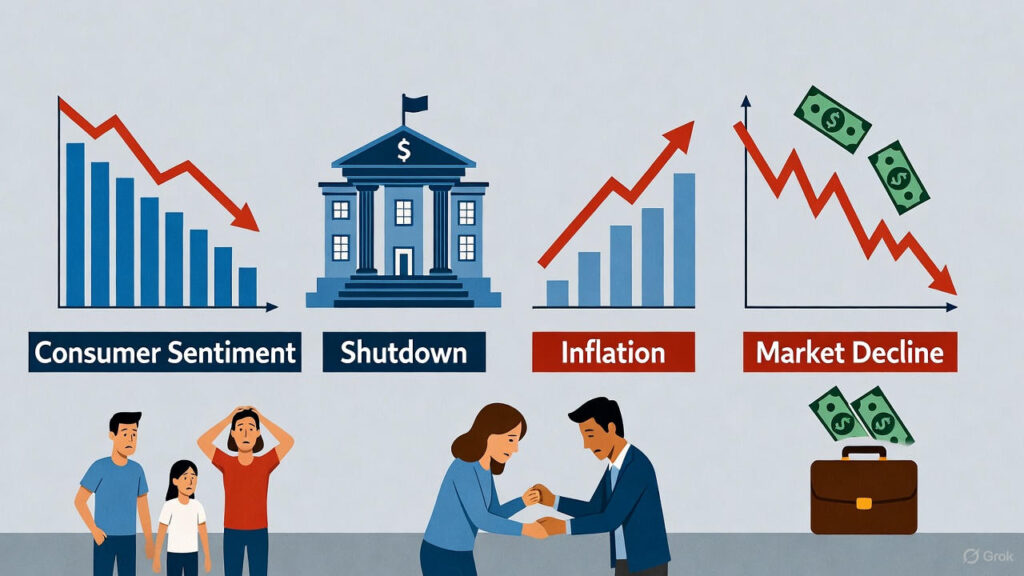
Based on the latest reports, here are the four major forces behind the collapse:
1. The Government Shutdown Is Draining Confidence
The longer it drags on, the deeper the uncertainty grows.
Households are worried about:
- delayed paychecks
- frozen federal programs
- suspended services
- unpredictable political outcomes
Shutdown-induced anxiety tends to bleed into spending behavior, especially when people believe the worst is ahead.
2. Inflation Expectations Are Rising Again
Even if inflation has cooled from pandemic highs, perception drives behavior. And right now, consumers are worried prices are headed back up.
This hits:
- groceries
- rent
- fuel
- utilities
- household essentials
When households expect prices to keep rising, they shift into defensive spending mode—cutting discretionary purchases and delaying big-ticket items.
3. Cooling Job Security
While unemployment remains low overall, layoff announcements are rising across:
- tech
- banking
- manufacturing
- retail
- logistics
When people fear layoffs, they spend like a recession is coming—even if GDP numbers still look healthy.
4. Declining Stock Market Confidence
Markets have been volatile for weeks.
Consumers are noticing.
Retirement accounts are dipping.
Portfolio values are softer.
And risk appetite continues to shrink.
The data shows that financial confidence and market performance are tightly linked—making this decline in sentiment especially concerning for investors.
## ⚠️ Why Wall Street Should Care About This Drop
Normally, consumer sentiment fluctuates from month to month.
This wasn’t normal.
This was a steep, broad, and fast collapse.
It matters because:
→ Consumer spending = 70% of U.S. GDP
If sentiment stays low, spending will follow.
→ Consumer stocks are exposed
Retail, travel, autos, discretionary tech—these sectors are vulnerable to pullbacks.
→ Corporate earnings could get hit next quarter
Weak confidence today often becomes weaker earnings tomorrow.
→ Investors may shift into defensive positioning
That means:
- utilities
- consumer staples
- healthcare
- gold
- bonds
→ The Fed will take this seriously
The central bank has already been juggling inflation vs. growth.
A consumer confidence crash may force its hand.
## 💼 How This Affects Everyday Americans
Households are already making visible adjustments:
1. Cutting discretionary spending
Fewer restaurant trips.
Less travel.
Smaller holiday budgets.
2. Delaying major purchases
Cars, appliances, electronics, home improvement—Americans are tapping the brakes.
3. Increasing credit card usage
High inflation → high rates → expensive debt.
A dangerous combo.
4. Growing emergency savings focus
Financial caution is rising fast.
5. Rising interest in side hustles
Searches for “extra income” and “remote work part-time” are climbing.
When consumer sentiment crashes, behavior changes quickly—and usually stays that way for months.
## 🧮 Economic Outlook: Are We Heading Into a Slowdown?
Economists aren’t calling for a recession—yet.
But the warning signs are flashing.
🔻 Risk #1: Weakening Q4 spending
Retailers may see slower holiday sales.
🔻 Risk #2: Rising household debt stress
High APRs are squeezing budgets.
🔻 Risk #3: A Fed policy dilemma
If sentiment drops further, the Fed may need to cut rates sooner.
🔻 Risk #4: Market volatility
Stocks may swing harder as consumer sectors wobble.
🔻 Risk #5: Corporate earnings downgrades
Wall Street analysts could start trimming growth forecasts.
In short:
The U.S. economy isn’t collapsing—but the foundation is shaking.
## 🧭 The Wink Take
This isn’t a blip.
This is a sentiment crash, and it deserves attention.
When Americans lose confidence, the economy feels it.
When the economy feels it, markets react.
And when markets react, investors start looking for shelter.
The next 30–60 days will determine whether this is a short-lived shock—or the early chapter of a broader slowdown story.
Stay alert.
Stay nimble.
Catch the Wink… before the market blinks.
🔗 Read Next on DollarWink
👉 https://dollarwink.com/investments-that-survive-crashes-2025/