Business trips just got a glow-up.
Across the country, workers are transforming corporate travel into mini-vacations — and saving thousands while doing it.
Instead of rushing home after the meeting, Americans are using work trips to piggyback personal travel, stretch budgets further, and squeeze real lifestyle upgrades out of corporate itineraries. And this new trend? It’s booming.
Welcome to the “Workcation 2.0” generation, where TikTok meets expense reports — and suddenly the math starts to make sense.
Why Work Travel Mini-Vacations Are Exploding in 2025
This year’s shift didn’t happen by accident.
Here’s what’s fueling the work travel mini-vacations wave:
✨ 1. Corporate travel is back — big time.
After years of cuts, companies are:
- attending more conferences
- rebooting in-person client meetings
- approving more domestic travel
That means more flights, more hotel nights, and more opportunities to extend travel at personal cost — but at a huge overall savings.
✨ 2. Americans are burned out — and hacking the system.
Workers are combining PTO with work trips because:
- flights are already covered
- hotels are partially covered
- they can “add on” leisure days at a fraction of the normal price
The result?
A $1,200 personal getaway becomes a $250 side-trip, depending on what the company already pays for.
✨ 3. Inflation is forcing creativity.
With vacations more expensive than ever, people are using business travel to:
- visit new cities
- try restaurants
- enjoy a mental reset
…without suffering the full cost of a normal trip.
This isn’t extreme budgeting — it’s smart lifestyle ROI.
The Math Behind a $5,000 Work-Travel Boost
How do Americans turn a basic work trip into a $5,000 lifestyle upgrade?
Let’s break it down:
1. Flights (Saved: $300–$700)
If the company covers:
- round-trip airfare
- checked baggage
- airport transfers
That’s hundreds saved before your trip even begins.
2. Hotels (Saved: $400–$1,500)
Workers are booking:
- personal nights at corporate rates
- discounted add-ons
- cheaper weekend extensions
A two-night extension can cost half the normal rate.
3. Meals (Saved: $150–$300)
Work meals are covered during:
- conference days
- client meetings
- travel days
Americans then divert personal budgets toward leisure experiences instead.
4. PTO Optimization (Value: $500–$1,200)
By tying PTO to work travel:
- 1 vacation day can feel like 3
- weekends maximize value
- travel fatigue disappears
Workers repeatedly call it “PTO stacking.”
5. Experience Value (Priceless—but generally $500–$2,000)
This includes:
- exploring new cities
- visiting family near the travel destination
- enjoying free amenities
- attending events, concerts, shows
It’s not just money saved — it’s lifestyle value gained.
Add it up?
A simple two-day work trip can easily deliver up to $5,000 in value once flights, hotels, experiences, and time-saved math are included.
How People Are Doing It Without Crossing HR Lines
Nobody wants trouble with accounting — so the Work-Travel Mini-Vacation trend follows new unwritten rules:
✔️ 1. Only extend after company business ends
Employees pay for all personal nights separately.
✔️ 2. No expensing personal meals or activities
Workers stay on the right side of compliance.
✔️ 3. PTO must be officially logged
No blurry lines.
✔️ 4. All savings are personal — not at company expense
Corporate perks become leverage, not exploitation.
Employees call this ethical hacking — maximizing what’s allowed without crossing boundaries.
Where Americans Are Extending Their Trips
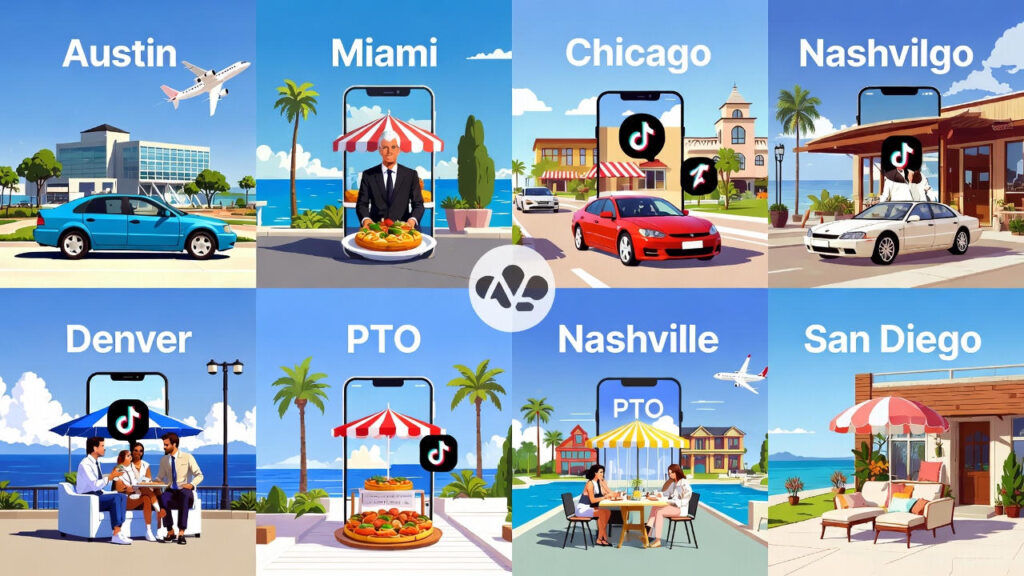
These are now the top mini-vacation destinations tied to work travel:
- Austin — food + festivals
- Miami — beaches + nightlife
- Chicago — architecture + food
- Denver — nature + breweries
- Nashville — concerts + culture
- San Diego — perfect weather
Major conference cities = the best side-trip cities.
How Social Media Made This Trend Even Bigger
TikTok and Instagram are full of:
- “stay an extra 48 hours” hacks
- flight upgrade tricks
- hotel extension secrets
- “worktrip glow-up” vlog trends
Creators call it “Corporate Girl Travel,” “Smart PTO,” and “Business-Trip Stacking.”
It’s part lifestyle, part budgeting — and part quiet rebellion.
🧭 The Wink Take
The work travel mini-vacations trend isn’t just about saving money — it’s about reclaiming time, boosting mental health, and stretching lifestyle value in a high-inflation world.
Americans aren’t splurging.
They’re hacking the system — ethically, smartly, and with serious ROI.
Corporate travel is back.
And now? So are mini-vacations.
🔗 Read Next on DollarWink
👉 https://dollarwink.com/americans-working-remote-travel-2025/