Something big is happening in America — and it isn’t slowing down.
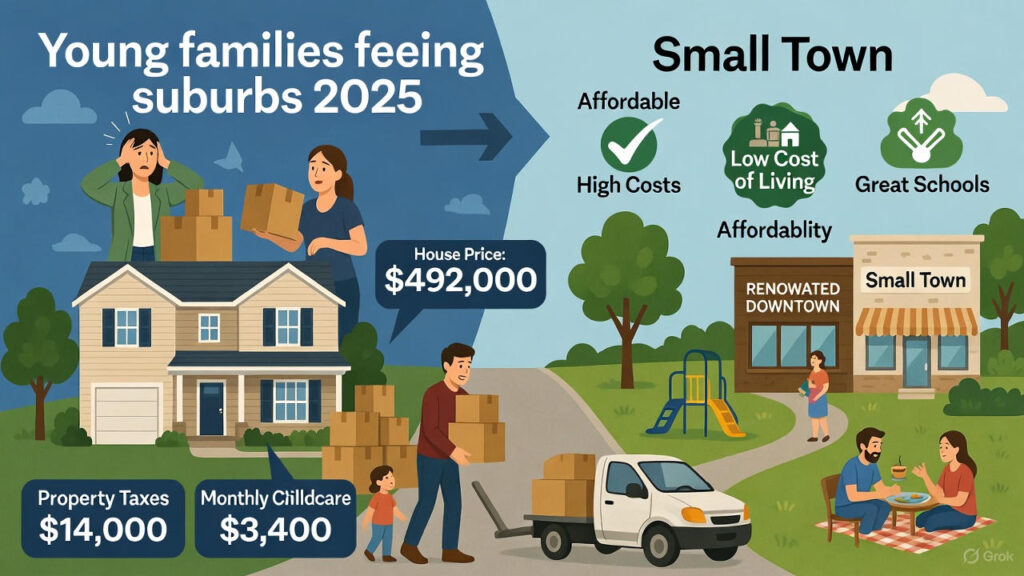
Young families are fleeing the suburbs in 2025, trading Target-run culture, morning traffic, $4,000 mortgages, and never-ending HOA warnings for cheaper, calmer, smaller towns where life feels human again.
This is no “quirky trend.”
It’s a migration wave reshaping housing markets, school districts, local economies, and the entire idea of what the American dream even is.
Millions of parents under 40 are asking themselves:
“Why are we paying this much to be stressed, tired, and broke?”
For more and more families, the answer is simple:
They don’t have to.
## 🌄 The Great 2025 Lifestyle Reset
Suburbs used to be the promised land — a symbol of stability, space, and safety. In 2025, they’ve become symbols of:
- debt
- long commutes
- high childcare costs
- inflated home prices
- overextended budgets
- chronic burnout
Small and mid-size towns, on the other hand, have become:
- affordable
- calmer
- community-driven
- closer to nature
- lower-pressure
- financially realistic
Zoom out, and you see the truth:
Young families fleeing suburbs aren’t escaping a place — they’re escaping a lifestyle that stopped making sense.
## 💸 The Financial Math No Longer Works
The biggest driver is painfully simple:
Suburban costs have exploded.
Here’s what families are facing in 2025:
- Median suburban home price: $492,000+
- Average property tax in many metro suburbs: $8,500–$14,000 per year
- Childcare for two kids in major metros: $2,600–$3,400 per month
- Suburban commute expenses: $500–$900 per month
- HOA fees: $150–$500 per month
- Car payments (often two): $800–$1,500 per month
When couples sit down with a spreadsheet, they realize:
“We’re earning more than our parents but somehow have less freedom.”
Small towns flip the math:
- Lower home prices
- Lower property taxes
- More flexible childcare options
- Reduced transportation costs
- Fewer lifestyle “pressure expenses”
Many families report savings of $1,000–$2,500 per month after relocating — money that finally goes toward emergency funds, vacations, savings… or just breathing.
## 🏡 The Suburban Dream Became a Stress Factory
Let’s call it out:
Suburban life in 2025 feels like a never-ending competition.
- Who has the best lawn?
- Who’s upgrading their kitchen next?
- Who’s paying $300 for toddler gymnastics?
- Who’s signing up for $2,000 summer camps?
- Who has the newest SUV?
It’s a lifestyle built around spending — not living.
Young parents say it out loud now:
“It’s not that we hate suburbs. We just hate being broke and exhausted.”
So they’re moving where expectations are lower — and happiness is higher.
## 👶 Childcare Is the Silent Killer of Family Budgets
Childcare is the tipping point for millions.
In many suburban regions:
- Full-time daycare costs more than in-state college tuition
- Many families pay more for childcare than rent or a mortgage
- Waitlists are months to years long
Small towns offer:
- In-home childcare
- Family support networks
- Lower-cost daycare options
- Community-based programs
- Subsidized local initiatives
For young parents navigating impossible math, small towns aren’t just an option — they’re a lifeline.
## 🛣️ Commute Culture Is Dying
Remote and hybrid work didn’t just change office culture.
They changed family geography.
Families realized:
- “We don’t need to live near downtown.”
- “We don’t need the ‘30-minute commute’ that’s actually 80 minutes.”
- “We don’t need to spend thousands on gas and parking.”
A two-parent commute can cost $8,000–$12,000 a year.
Small towns give that time — and money — back.
Even hybrid workers only need a train line or reasonable drive distance a few days a week. And towns near regional hubs (e.g., Scranton, Bethlehem, Davenport, Boise suburbs, Greenville, smaller Texas metros) are booming because of exactly this.
## ❤️ Smaller Towns Offer What Suburbs Can’t: Community
Not the fake “community newsletter” kind.
Real community.
Families talk to neighbors.
Kids walk to school.
People actually know the guy at the local coffee shop.
There are fewer strip malls and more parks.
Less traffic, more time.
Less noise, more nature.
Young parents call it “emotionally affordable.”
This shift is more than financial — it’s a cultural counter-move to the burnout economy.
## 📈 Real Estate Trends: Small Towns Are Surging
Realtors nationwide are reporting:
- increased demand in towns under 50,000 population
- bidding wars shifting from suburbs to rural-adjacent markets
- millennials dominating small-town purchases
- builders shifting focus to lower-cost regions
The “Zoom Town” wave from the pandemic didn’t die — it matured.
And now it’s driven by families, not single workers.
## 🚀 The New American Dream: “Enough, Not Excess”
For decades, the American dream was:
- a big home
- two cars
- great schools
- yard, garage, cul-de-sac
Today’s young families have rewritten it:
- financial stability
- time with kids
- lower stress
- nature access
- flexible work
- affordable living
They want a life that feels sustainable, not performative.
And for millions, that means leaving the suburbs behind.
## 🔍 The Psychological Shift Behind the Moves
Financial pressure started the trend.
But lifestyle clarity is accelerating it.
Families say:
- “We want more time, not more house.”
- “We’re tired of performing success instead of living it.”
- “We want our kids to have a childhood, not a schedule.”
- “Why pay for things that don’t make us happier?”
It’s a cultural breakaway — a quiet rebellion wrapped in moving boxes.
## 🌐 Small Towns Are Modernizing Fast
The stereotype of “nothing to do” small towns is outdated.
In 2025, many offer:
- fiber internet
- new coworking spaces
- renovated downtowns
- microbreweries, cafés, indie shops
- outdoor trails
- community centers
- strong school districts
- local entrepreneurship
Families aren’t “giving up.”
They’re gaining what they lost in suburban sprawl.
## 🔮 What This Means for 2025 and Beyond
Economists expect:
- suburban home prices in expensive regions to cool
- small-town markets to rise
- school district shifts
- retail expansion in smaller towns
- increased infrastructure investment
- more families choosing remote-friendly regions
This migration wave is not temporary.
It’s structural.
The next chapter of American family life is being written far from the cul-de-sac.
🧭 The Wink Take
Young families aren’t fleeing suburbs because they’re running away — they’re running toward something better.
A calmer life.
A cheaper life.
A more connected, human, breathable life.
In 2025, the American dream isn’t a big house in the suburbs.
It’s a sustainable life in a place where money stretches, neighbors wave, and kids actually have room to play.
Catch the Wink.
The shift is only beginning.
🔗 Read Next on DollarWink
👉 https://dollarwink.com/gen-z-luxury/